Zero Gravity.

In 2001, Doo Interactive made CNES’s zero-gravity research visible to the public: the aircraft that cancels gravity, the science on board, and the cabin in 360°.

Case study · Doo Interactive · CNES · 2001–2003

Making microgravity visible

22 seconds at a time, thirty times a flight.

Some science only works without gravity: flames, bubbles, dust clouds and the human body all behave differently when weight disappears. Since 1997 a modified Airbus A300 had given European researchers that condition for about 22 seconds at a time, over and over in a single flight.

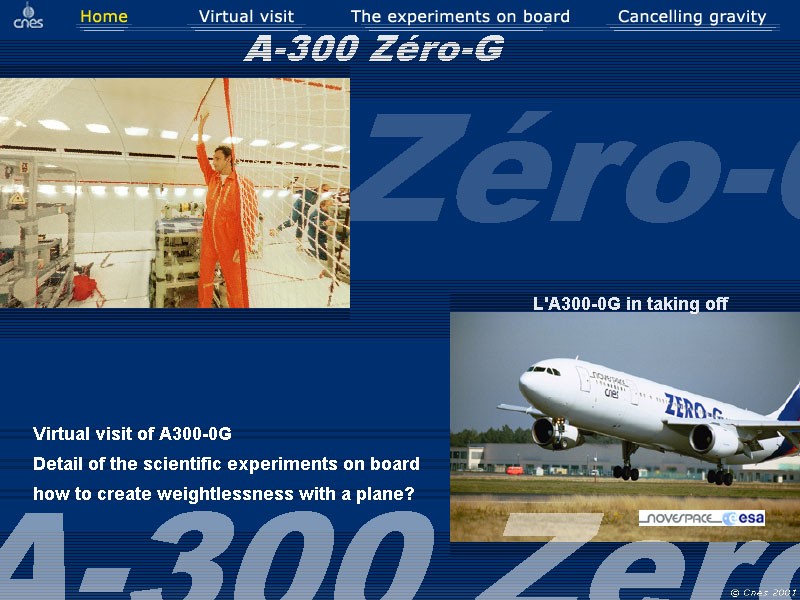
In 2001 CNES, the French space agency, commissioned Doo Interactive to make this research understandable to the public: what weightlessness is, how an aircraft creates it, and what scientists do with it. The answer was an interactive CD-ROM in French and English, built around a 360° visit of the cabin shot in flight, and updated in 2003.

The 2003 edition.
The 2001 disc: a virtual visit, the experiments on board, and how to cancel gravity.
History

From Caravelle to A310

1986
CNES creates Novespace, its subsidiary for parabolic flights, based at Bordeaux-Mérignac.
1988
Scientific parabolic flights begin on a Caravelle.
1997
The Airbus A300 Zéro-G enters service, with a padded cabin of about 100 m² for experiments.
2001
CNES commissions the interactive CD-ROM A-300 Zéro-G from Doo Interactive.
2003
Updated edition with new interactive video.
2014
The A300 retires after more than 13,000 parabolas and flies to Cologne/Bonn airport, where it is on display.
2015
The Airbus A310 Zero G takes over. Public discovery flights had opened in 2013.
13,000+

parabolas flown by the A300

~22 s

of weightlessness per parabola

113

scientific campaigns

The science

Cancelling gravity with a parabola

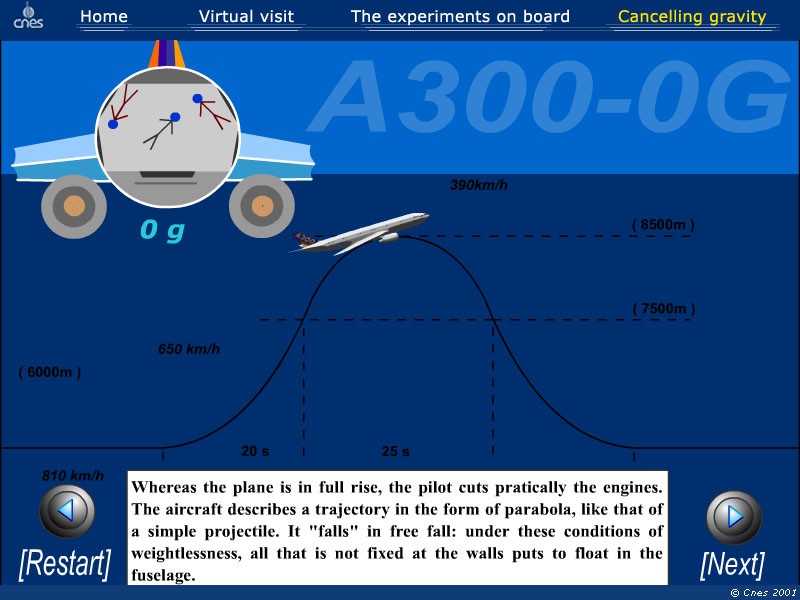
From level flight the aircraft pulls up steeply and everyone on board weighs about 1.8 times their normal weight. The engines are then throttled back until they only cancel air drag, and the aircraft, its passengers and every loose object follow the same ballistic curve, like a thrown stone. Falling together, nothing presses on anything: for about 22 seconds, everything floats. The aircraft pulls out of the dive, heavy again, and sets up the next one, about thirty times per flight.

Strictly speaking this is microgravity, not zero gravity: gravity is still there, but its effects disappear because everything falls at the same rate, exactly as on a space station in orbit.

The parabola as animated on the 2001 disc.
On board

The experiments, explained for everyone

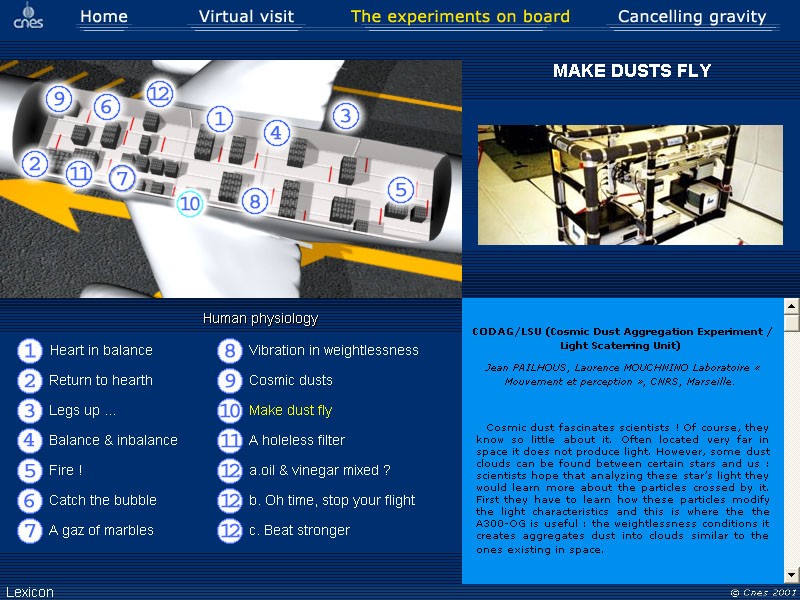
The core of the disc was a tour of the research on board, one experiment at a time, each placed on a plan of the cabin:

  • Combustion. Without weight there is no convection: flames change shape and smoke does not rise, a key question for fire safety on a space station.
  • Boiling and heat transfer. A bubble in heated silicone oil starts to pulse; the same physics is used to cool satellites.
  • Granular matter. Millimetre beads that pile up on Earth behave like a gas when floating, which helps explain why some propellant ingredients do not mix.
  • Cosmic dust. A laser through suspended dust shows how particles scatter light, a model for the CODAG/LSU cosmic dust experiment.
  • Human physiology. Blood pressure regulation, balance and posture, and walking movements studied without gravity.
Each experiment placed on the cabin plan, with its own explanation.
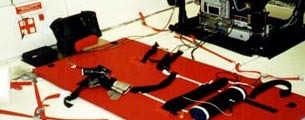
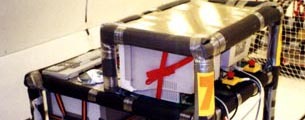
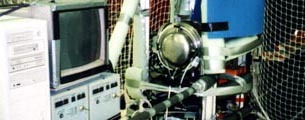
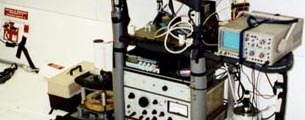
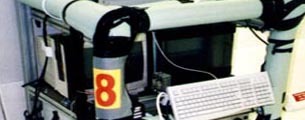
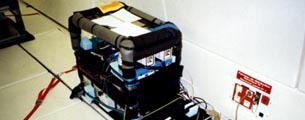
Experiment rack on board the A300 Zero-G
Step inside

The cabin in 360°, in weightlessness

The virtual visit was shot in flight with iPIX: two fisheye images, back to back, stitched into a full sphere. In the A300 there is no floor to set a tripod on for 22 seconds, and every parabola ends with gravity returning. Seven views shipped on the 2001 disc, one per zone of the cabin; an eighth comes from a later flight in 2004. All were converted in 2026 from the protected files on the disc into standard panoramas.

Closing a loop

A space technology, showing space research

iPIX itself came out of space research. It began at TeleRobotics International in Tennessee, whose Omniview system gave pan, tilt and zoom inside a fisheye image with no moving parts, so that robots could be steered by video. NASA’s Langley Research Center funded the work through a Small Business Innovation Research contract, and the team presented it at a NASA Johnson Space Center workshop in 1993.

A technology developed for space robots ended up documenting space research in an aircraft that recreates weightlessness. The group later patented its own method for stitching two fisheye hemispheres into a single image, now cited by GoPro, Qualcomm, Nvidia and IBM.

Applied technology in extreme conditions

From the caves to zero gravity

The environment changes. The discipline does not.

Capturing a cave, a weightless aircraft cabin or a clean room asks the same things: understand the subject, plan the capture, accept the conditions you cannot change, and deliver something people can explore and understand. That is the thread from Biron & Lascaux II to the A300 Zéro-G, and on to the satellites that followed.

Interactive CD-ROM produced by Doo Interactive for CNES, with Novespace, 2001; updated 2003. Doo Interactive was founded in 1998 and grew into a team of video editors and multimedia producers.

Read the first-person account on stephanejacob.com →

Facts: CNES, Novespace / Air Zero G, DLR, NASA Spinoff and NASA Technical Reports Server.

Scroll to Top