28 Years Later.
In 1999, Doo Interactive captured seven French heritage sites in 360° so people could visit them from home. Today, that idea has a name: the digital twin.
A digital twin before the word existed
Two CD-ROMs, seven heritage sites, every 360° view shot on film.
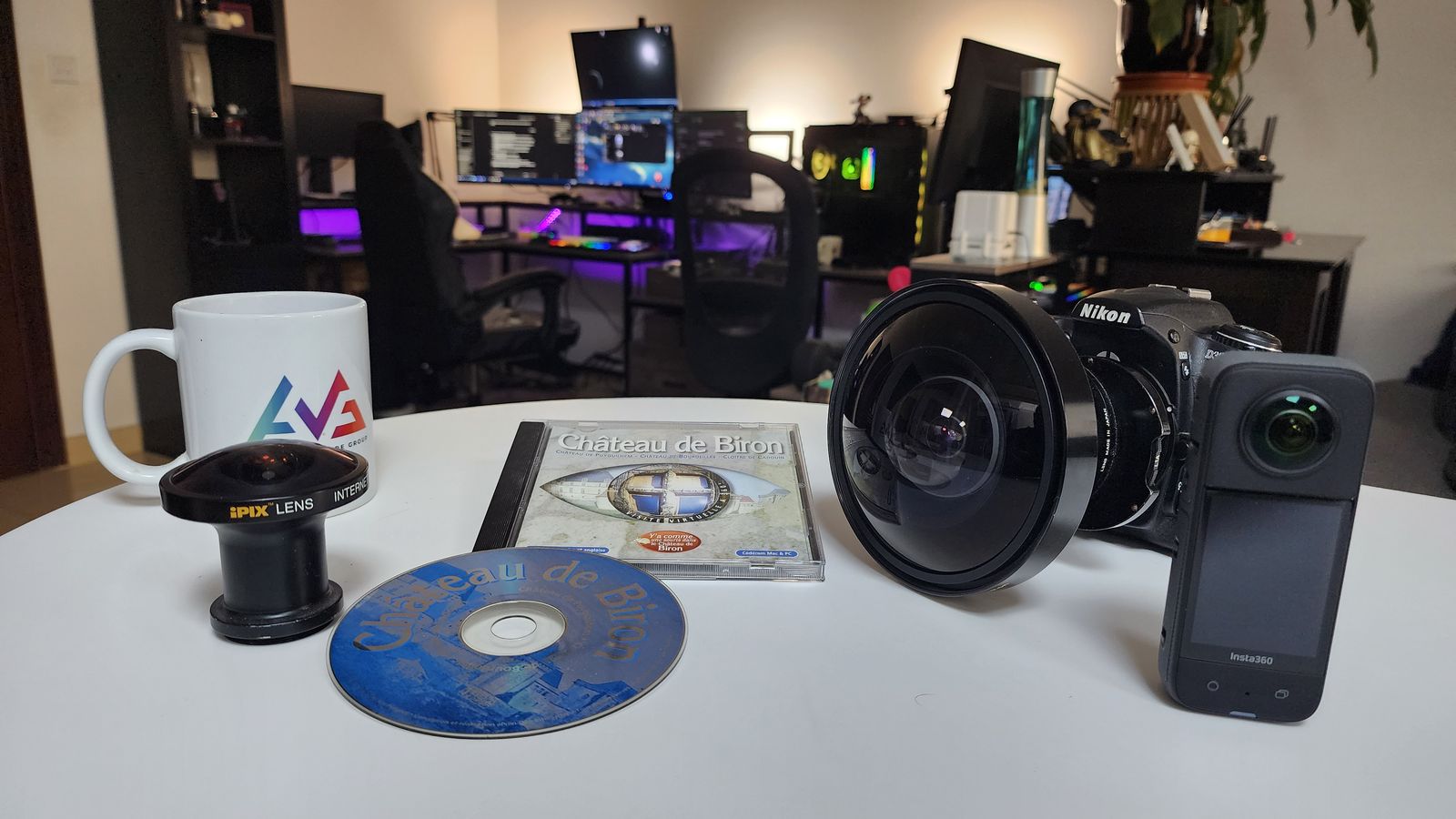
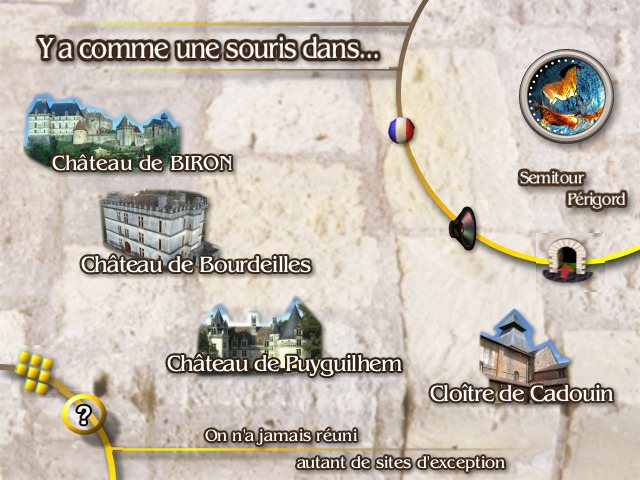
In 1998, Semitour Périgord asked for a way to take some of France’s best-known heritage sites home. Doo Interactive, founded that year, captured seven of them in 360°: the Lascaux II replica, Le Thot, the Abri Pataud, and the châteaux of Biron, Puyguilhem and Bourdeilles with the Cadouin cloister. The result was two dual-platform CD-ROMs, Lascaux II and Le Château de Biron.
Nobody called it a digital twin then. But the job was the same one: document something real, faithfully enough that people can explore it without being there. Twenty-eight years later, the discs still run, and every source file still exists.
Three ages of 3D
The technology changed. The purpose kept moving closer to reality.
What will be
In the 1990s, 3D mostly showed what did not exist yet: a building before it was built, a product before it was made.
What was
Then it began to show what existed before, and what was already there: heritage documented so it could be visited, studied and kept. Biron and Lascaux II belong here.
What is
Today a digital twin documents what exists and stays in sync with it, through sensors, live data and real-time monitoring.
Souvenirs that paid for the stones
The discs were sold on site, so visitors could take the visit home with them. That shaped everything: not an encyclopaedia, but a good-looking, easy companion to a day out. The sales helped finance Semitour’s renovation work on the sites themselves.
The project came through aPrim Technologies, which held the relationship with Semitour Périgord. Doo Interactive brought the interactive know-how and designed, shot and built both discs.
CD-ROMs, PC and Mac
heritage sites
copies produced
Capture first. Then fit it through a 2x drive.
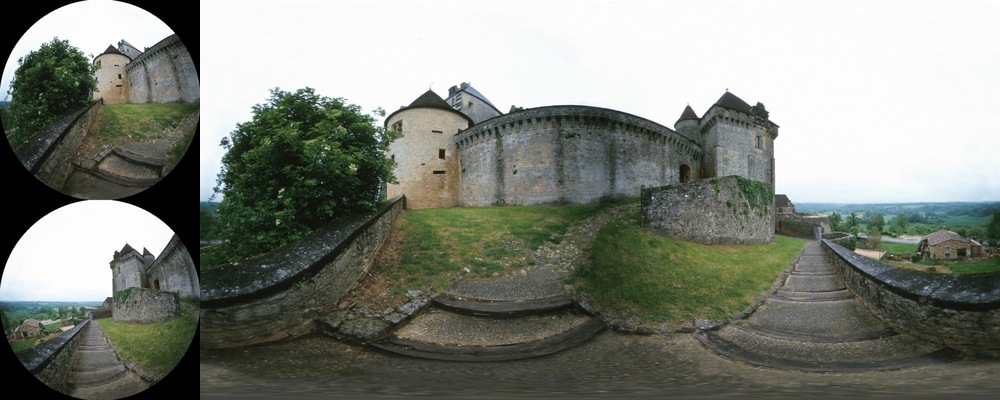
Capture. No digital camera of 1998 could deliver an immersive tour, so every 360° view was shot on film with a fisheye lens, scanned and stitched with iPIX. A bad frame meant a trip back to the site. The flat photographs were shot on one of the first consumer digital cameras, a Nikon Coolpix 900 at 1280×960.
Two platforms. Windows and Mac OS shared no file system, no video format and no executable. Each disc was a hybrid: one shared partition for the media, with a launcher for each system.
Run from the disc. Nothing was installed on the hard drive except drivers, codecs and a launcher icon. Every screen, sound, video and 360° view played straight from the CD, and the minimum requirement was a 2x drive: 2 × 150 KB/s. Everything had to stream under 300 KB/s, on CRT monitors at 640×480.
one disc each
a 2x CD drive: the ceiling for everything
the screen everyone had
The disc, running again
In 2026 the Biron disc was opened again: its Director files decoded, its home menu rebuilt exactly as authored in 1999, and the original disc recorded running in a virtual machine.
Shot on film in 1999, explorable on your phone today
Every 360° view from the Biron disc: 21 iPIX images from 1999, converted in 2026 straight from the protected files on the disc into standard panoramas, plus one from inside the Lascaux II replica. Drag to look around, pick a site, or step through them with the arrows.
From a souvenir disc to a digital twin
The capture discipline never changed. The purpose grew.
The 360° work did not stop with Biron. Turning fisheye images into a seamless sphere led to one of the group’s four granted patent families: a method for stitching two fisheye hemispheres into a single image without loss, now cited by GoPro, Qualcomm, Nvidia and IBM.
That is where the line runs from 1999 to today. A digital twin is a faithful model of something real, built to understand it, test it and look after it. In 1999 the model was a souvenir disc of a castle. Today it is a building, a site or an installation, kept in step with live data. The first rule has not changed: capture it properly.
Château de Biron on Abandonware France
Catalogued as a 1999 title for Windows 9x and Mac OS 9, published by Semitour Périgord, with 25 screenshots and a review. Independent proof that the disc is still remembered, and still runs, 28 years later.
Good workflow survives any technology
The deliverables changed. The process did not.
Understand the brief. Capture the raw material properly. Prepare and edit it. Assemble the experience. Test it on every target. Deliver it. Archive everything.
Every source file from these discs survived: three copies on separate physical media, in separate locations, from day one. And because the discs ran offline, there was nothing to switch off. When the cloud goes down or the tools fail, the teams that cope are the ones who still know how to do it the old way.
Lascaux II and Le Château de Biron were produced for Semitour Périgord by Doo Interactive.